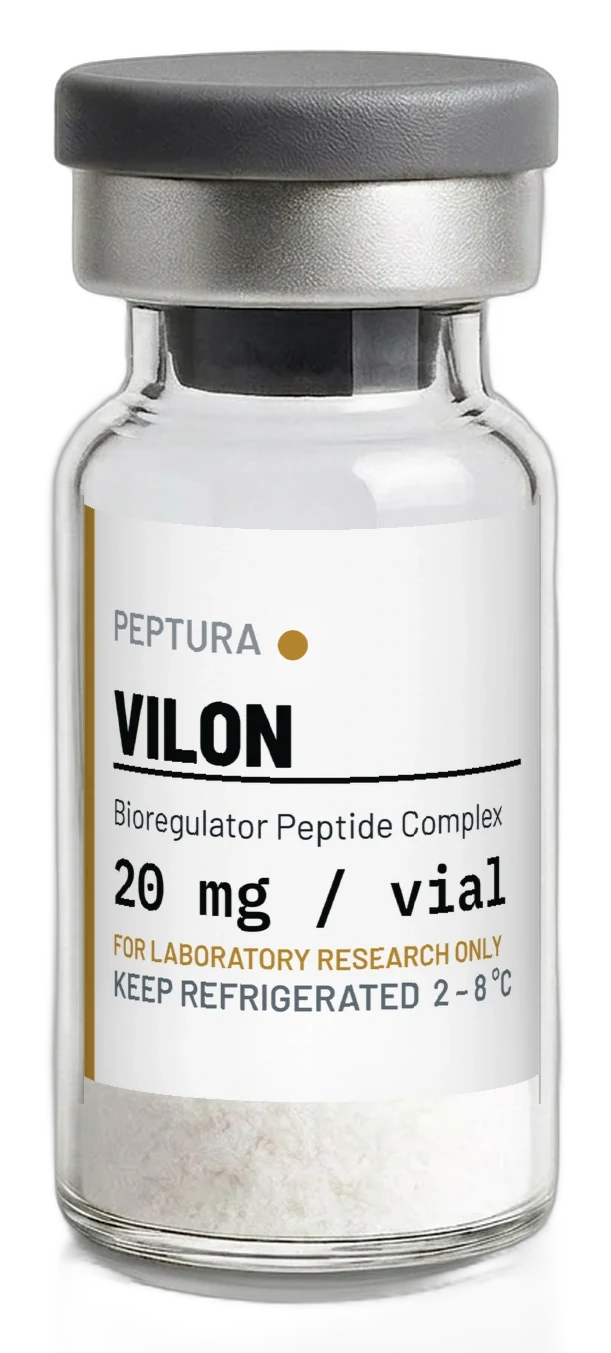
Vilon.
About Vilon
Vilon is studied in tissue regeneration and repair research, including cell and animal models. Credited with immunomodulatory activity through promotion of T-cell differentiation and thymic function; in animal studies it inhibited growth of spontaneous tumors and extended lifespan in mice, often studied in combination with Epitalon.
Research Application
By far the most broadly researched peptide in this family: published animal studies cover tumor growth and lifespan, digestive enzyme activity, stress resistance, and cardiac gene expression. Controlled human studies are nonetheless entirely absent.
Important to know
Claims circulating online are often not backed by valid clinical data. Treat all information as a starting point for your own scientific research, not as usage guidance.
Sequence and regulatory status data are based on publicly available sources and refer to the compound in general, not to a specific product.
Research Overview
Studies on regenerative peptides are mostly derived from cell culture and animal models; comprehensive clinical data is typically still limited.
- Khavinson VKh, Anisimov VN. Dokl Biol Sci. 2000;372:261–263. PMID 10944717
- Anisimov SV, Bokheler KR, et al. Bull Exp Biol Med. 2002;133(3):293–299. PMID 12360356
- Koplik EV, et al. Ross Fiziol Zh Im I M Sechenova. 2002;88(11):1440–1452. PMID 12587272
References without a PMID can be located via the respective publisher. This overview does not claim to be exhaustive.
Similar Peptides
Question about Vilon?
We reply personally – via email or Telegram.