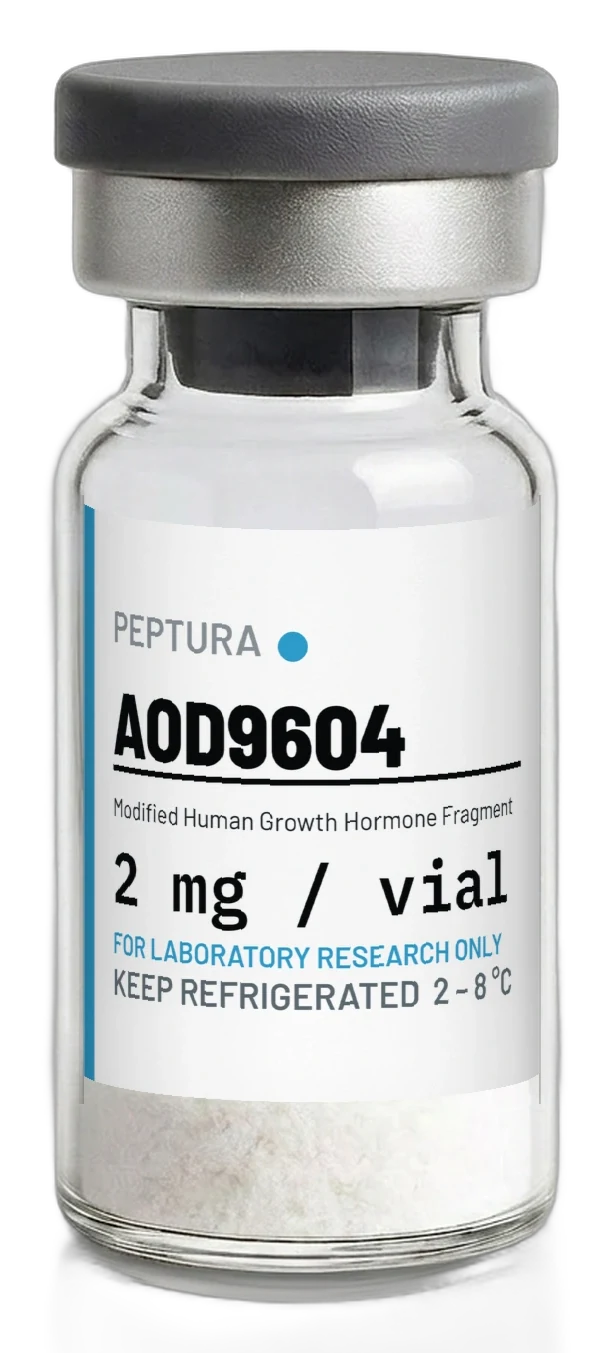
AOD9604.
About AOD9604
AOD9604 is among the compounds studied in metabolic and weight-regulation research. The fragment is separated from growth hormone's receptor-binding region and instead activates the beta-3 adrenergic receptor on fat cells, triggering lipolysis. It does not bind the GH receptor and had no measurable effect on IGF-1 or blood glucose in trials.
Research Application
Originally developed as an anti-obesity compound intended to trigger fat breakdown without the typical GH-related metabolic effects. Development was discontinued in 2007 after non-significant Phase 2b results — it now serves mainly as an example of a GH-receptor-independent lipolysis approach in research.
Important to know
Claims circulating online are often not backed by valid clinical data. Treat all information as a starting point for your own scientific research, not as usage guidance.
Sequence and regulatory status data are based on publicly available sources and refer to the compound in general, not to a specific product.
Research Overview
A growing number of preclinical and clinical studies exist for metabolic peptides, though the volume varies significantly by substance.
- Heffernan M, et al. Endocrinology. 2001;142(12):5182–5189. PMID 11713213
- Ng FM, et al. Hormone Research. 2000;53(6):274–278. PMID 11146367
- Stier H, Vos E, Kenley D. J Endocrinol Metab. 2013;3(1–2):7–15.
- Kwon DR, Park GY. Ann Clin Lab Sci. 2015;45(4):426–432. PMID 26275694
References without a PMID can be located via the respective publisher. This overview does not claim to be exhaustive.
Question about AOD9604?
We reply personally – via email or Telegram.